


Summer is officially here, and with it comes cold coffee season. Hot lattes and steaming drip give way to huge cups of iced coffee and summer drinks. Yes, of course, the big chains like Starbucks and Dunkin’ are advertising their colorful cold beverages. But there are tons of ways to enjoy the taste of cold coffee this summer without defaulting to whatever the massive corporations are selling. There are more options than ever for enjoying coffee at home, and cold coffee is no exception. Here you’ll find a guide to how to prepare and store cold coffee at home.
Cold Brew vs. Iced Coffee
Before we get started, however, we should clear up some potential confusion. There are several terms out there for cold coffee, most commonly “cold brew” and “iced coffee.” But not all cold coffee drinks are made the same way, and despite how these terms are used, they’re not necessarily interchangeable.
Iced coffee is coffee that has been brewed hot and then cooled, whether by ice or refrigeration. Iced coffee is often made to be more concentrated than its hot drip counterpart because of the flattening effect ice has on the drink. If you’re ordering or looking to make your own iced coffee, then you start by brewing hot. In other words, iced coffee is made via percolation. Percolation is the process of water traveling through coffee grounds to make the coffee drink.
Cold brew, on the other hand, is coffee brewed at room temperature. Typically, this involves very coarse coffee grounds sitting immersed in room temperature water. This process lasts hours and results in a cold brew concentrate that then needs to be cut by ice or water. In other words, cold brew is made via immersion.
It’s been said that cold brew and iced coffee are cousins not siblings. They are both methods of making cold coffee, but they involve different processes and do not usually taste the same. This guide includes options to make both cold brew and iced coffee, but just in case you’re coming into the cold coffee game using these terms interchangeably, know that there is a difference.
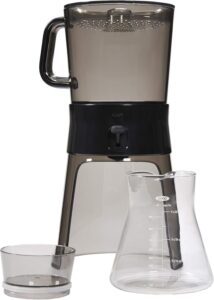
Method #1: Your Own Cold Brew
Making your own cold brew is a great option for having cold coffee at home. Cold brew makers are fairly cheap and easy to come by. We’re a fan of the OXO Good Grips Cold Brew Coffee Maker for its simple design and low price point. With it, you can prepare a batch of up to 32 oz of cold brew concentrate.
The process is pretty straightforward. You add extremely coarse grounds and water to the brewing container and let steep anywhere from 12 – 24 hours, depending on the amount. When you’re ready to finish, simply press down on the brew-release switch, and the mixture will drain out of the container into the carafe. You now have cold brew concentrate that you can mix with water or milk to your liking.
Cold brew is a great way to make batches of cold coffee at a time. We recommend this method for folks who just want to be able to reach for their cold black coffee with minimal fuss. We also recommend it if you prefer your cold coffee mixed with milk. The batching process may be lengthy, but the result is your very own cold brew.
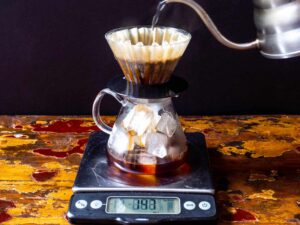
Method #2: Iced Pour-Over
If you’re looking for your cold coffee to have all the flavor and depth you get out of a pour-over, then you’re in luck. For years now, recipes have circulated for a Japanese-style iced coffee in which hot water is poured directly onto a batch of ice. This method is great for people looking for a pour-over’s complexity of flavor in their iced coffee. So long as you don’t mind doing a little more hands-on word for one serving.
The first thing to understand about an iced pour-over is that the ice will dilute your coffee, so you will need to start the process with double the amount of coffee grounds you usually use. The ice will balance out this double-strength batch of grounds. For your coffee-to-water ratio, you can still use the standard 1:16, but you’ll need to split the water portion between the water you’ll use for brewing and the ice in your carafe. A 60% hot water to 40% ice ratio should do the trick.
The following recipe calls for 25 g of ground coffee, 150 g of ice, 250 g of hot water.
- Prep the ice by placing it inside of your carafe. Then place the brewer, filter, and grounds on top.
- Bloom the coffee by adding approximately 50 g of water to the bed of grounds. Let sit for 30-45 seconds to allow the grounds to degas.
- Add the remaining 200 g of hot water in a careful circular motion to the bed of grounds. Once all the hot water is added, give the dripper a gentle swirl to catch any stray grounds.
- Once all the coffee has poured through, give the carafe a gentle swirl to encourage any remaining ice to melt.
- Pour the finished mixture into a serving vessel of your choosing filled with fresh ice.
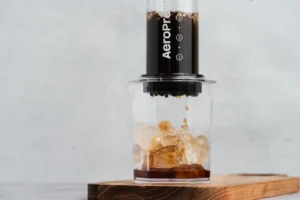
Method #3: Iced AeroPress
Yes, you can even make cold coffee using an AeroPress. Truly, the most versatile brewer on the market is the gift that keeps on giving. We actually included a recipe for iced AeroPress coffee on our breakdown of four recipes for the AeroPress. If you’re alright with a little manual work for one cup of iced coffee but don’t have any pour-over equipment, then we recommend using an AeroPress.
The recipe published by James Hoffmann in his book How to Make the Best Coffee at Home (pgs. 118-119) still applies.
- Place a filter inside of the filter cap. Lock the cap into the chamber. Place the chamber on a sturdy mug or carafe filled with 160g of ice.
- Add 22g of coffee grounds to the chamber.
- Slowly add up to 240g water to the chamber. Like with the inverted method, you want to make the chamber as full as possible.
- Place the plunger into the chamber, but do not press down. Keeping the plunger here will create a vacuum and prevent the water from drawing down.
- Wait 4 minutes.
- Gently swirl the mixture by lifting the mug and chamber. Wait another minute.
- Gently press the plunger down until it touches the grounds.
- Pour the mixture over ice and enjoy.
Conclusion
There are many more methods out there for achieving a delicious cup of cold coffee, but we think these 3 are an excellent place to start. Cold brew is great if you want a relatively low-fuss batching method or if you prefer your coffee with milk added. Making your own serving of iced coffee either with the pour-over or AeroPress method will get an expressive cup best consumed black. Regardless of your preference, there are a lot of options you have for making your own delicious cold coffee at home.